You can raise all the capital in the world, but if your team culture is weak, your startup is already on shaky ground.”
The Silent Startup Killer
When we talk about startup failure, most conversations orbit around one thing: money.
Burn rates, runways, cash flow mismanagement — these are the usual suspects blamed when a promising startup goes under.
But here’s the uncomfortable truth many startups run out of culture long before they run out of cash.
A team that’s disengaged, distrustful, or divided can drain momentum faster than any balance sheet.
Investors might fund your idea, but only your culture can fuel it.
In the early stages, your startup’s culture isn’t a “nice-to-have” — it’s your survival code.
Let’s unpack why culture collapses so often precede financial ones, and what founders can do to build cultures that don’t just survive, but thrive under startup pressure.
1. Culture Is the Invisible Operating System
Think of your startup like a smartphone. The product, strategy, and marketing are apps — they can be updated, replaced, or pivoted.
But your culture? That’s the operating system. If it’s buggy, everything crashes eventually.
Every decision — from hiring your first developer to responding to customer complaints — runs on that unseen code. The way you communicate, resolve conflict, celebrate wins, and handle setbacks defines how well your startup executes under pressure.
Startups that ignore culture early on often wake up too late — when toxicity has taken root and the best people start walking out the door.
2. Founders Shape Culture More Than Founders Think
Every startup inherits its culture from the founder’s DNA — not the values on the office wall, but the values in action.
If a founder is transparent, inclusive, and humble, the culture reflects that.
If the founder is ego-driven, reactive, and erratic, the culture mirrors that too.
Founders often underestimate how their daily behavior sets the tone.
Do you interrupt your team in meetings?
Do you tolerate poor collaboration because someone delivers results?
Do you celebrate learning as much as performance?
Each of these micro-decisions either strengthens or sabotages your culture.
Culture is caught, not taught.
Teams imitate what leaders do, not what they say.
3. Cash Can’t Buy Cohesion
Raising capital can mask culture cracks — but only for a while.
When startups get funded, they often accelerate hiring, expand offices, and chase growth metrics. But if the core culture isn’t stable, scaling only multiplies dysfunction.
Money can’t buy trust, accountability, or shared purpose. You can pay salaries, but you can’t pay people to care.
Without a healthy culture, every new hire adds complexity, not capacity.
As one investor put it, “A startup doesn’t burn out because of lack of funds — it burns out because of friction.”
A simple truth:
A bad culture burns money faster than any failed ad campaign.
4. The Early Warning Signs of Cultural Decay
Founders often miss the early symptoms of a culture that’s quietly eroding.
Here are the red flags:
- High performer, low trust: You’re keeping people who deliver results but damage morale.
- Silence in meetings: People no longer challenge ideas; they just comply.
- Burnout as a badge: Long hours and heroics are glorified over sustainable performance.
- Gossip instead of feedback: Issues get discussed in corridors, not conference rooms.
- Turnover in key roles: Especially if talented mid-level leaders are leaving.
If you see two or more of these signs, you don’t have a business problem — you have a culture leak
And like a leak, it doesn’t fix itself. It grows quietly until it floods everything.
5. Why Founders Delay Culture Work
It’s understandable — when you’re racing against time and competition, culture work feels abstract.
You’re juggling product-market fit, investor decks, and customer acquisition — who has time for team values and leadership reflections?
But here’s the paradox:
The faster you move, the more culture matters.
Startups don’t fail because founders don’t care about culture — they fail because they assume culture will take care of itself.
Spoiler: it doesn’t.
Culture either evolves intentionally or mutates accidentally.
6. Building a Culture that Scales: Practical Foundations
Let’s shift gears to the how.
Here are the foundational habits that strong startup cultures share.
a. Define the “Why” Early
Before you define your product, define your purpose.
Ask:
- Why do we exist beyond making money?
- What change are we here to create?
- Purpose becomes the north star that keeps teams aligned through pivots and pressure.
b. Hire for Values, Not Just Skills
You can train skills. You can’t train integrity, empathy, or teamwork.
During interviews, look for alignment with your startup’s values.
Ask behavioural questions like:
“Tell me about a time you disagreed with your team — how did you handle it?”
“What motivates you in a chaotic, fast-changing environment?”
Culture-fit hiring doesn’t mean hiring clones. It means hiring people who share the same principles, not the same personalities.
c. Design Transparent Communication Loops
The more your startup grows, the easier it is for silos to form.
Build rituals of transparency early:
-Weekly team check-ins
-Open dashboard of company metrics
-Anonymous feedback channels
Leadership “Ask Me Anything” sessions
Transparency builds psychological safety — the single biggest predictor of team performance, according to Google’s Project Aristotle study.
d. Celebrate Learning, Not Just Outcomes
Startups live and die by experimentation.
If your culture punishes mistakes, your team will play it safe.
Reward curiosity and learning — celebrate the failed experiments that generated insights, not just the wins that generated revenue.
e. Protect Work-Life Boundaries
In startup culture, hustle is often glorified. But chronic overwork leads to disengagement and turnover.
Encourage rest, flexible schedules, and mental health days.
Remember: burnout is not a strategy.
7. Culture as Competitive Advantage
Investors often bet on teams, not products. Why?
Because markets evolve, technology changes, and business models pivot — but a cohesive, resilient team can adapt faster than competitors.
A strong culture compounds like interest. It enhances:
- Speed: Less politics, faster decision-making.
- Innovation: Psychological safety fosters creative risk-taking.
- Retention: Talented people stay where they feel valued and heard.
- Brand reputation: Customers can sense authentic culture — it shows up in every interaction.
In a world where products are easily copied, culture becomes your ultimate moat.
8. Case Studies: When Culture Made or Broke Startups
Case 1. Successes Shadowed by Culture Criticism
What happened: An ed-tech startup grew rapidly and was acquired in 2020 for ~$300 million.
Culture issues reported:
Employee harassment, high-pressure sales targets.
Long hours, expectations without proportional compensation.
“Toxic work environment” with allegedly normalised intimidation.
Takeaway:
Rapid growth and strong financial success can mask culture problems. If such issues are not addressed, they undermine employee trust, weaken morale, and increase reputational risk. Culture needs to be central, even (especially) during hypergrowth.
Case 2. When Overwork Becomes a Crisis
What happened: An engineer in a company’s AI division reportedly had the responsibilities of three people, a heavy workload, and an oppressive management style. Tragically, this led to the engineer’s suicide.
Cultural aspects:
-Poor distribution of responsibilities
-Lack of reasonable work-life boundaries
-Management practices that didn’t safeguard staff wellbeing
Impact:
Mortal risk, severe employee burnout, public criticism, erosion of trust among both internal and external stakeholders.
Lesson:
Having a culture that glorifies hustle without limits is dangerous. Doing so erodes psychological safety and, in extreme cases, leads to irreversible damage.
Case 3: Canva – Scaling with Heart
Canva, one of the fastest-growing startups in the world, invests heavily in cultural rituals — celebrating diversity, psychological safety, and open communication. Their co-founder, Melanie Perkins, emphasises empathy and humility as key leadership traits — proving that kindness scales profitably.
Case 4- Zoho Corporation – Leadership in humility
Leadership style & rural roots: Sridhar Vembu (co-founder) has emphasized sustaining jobs in smaller towns, grounding leadership in humility, simplicity, and purpose.
Decentralized operations and employee empowerment: Rather than concentrating everything in big metro cities, Zoho has fostered localized teams, which nurture belonging, reduce attrition, and give people more ownership.
Cultural consistency: Values have remained more stable, even while scaling up. This has helped them survive competition, keep employee loyalty, and maintain product quality.
9. Culture Is the Cashflow Multiplier
Let’s connect the dots:
Strong culture doesn’t just prevent failure — it amplifies financial performance.
Research from Deloitte and Gallup consistently shows that:
-Companies with strong cultures see 4x higher revenue growth.
-Engaged teams are 21% more profitable.
-Startups with aligned cultures retain over 80% of their top talent even during turbulence.
Culture is not a soft skill — it’s a hard advantage.
10. The Founder’s Culture Playbook
If you’re building or leading a startup today, here’s a simple playbook to keep culture alive even when you’re scaling fast:
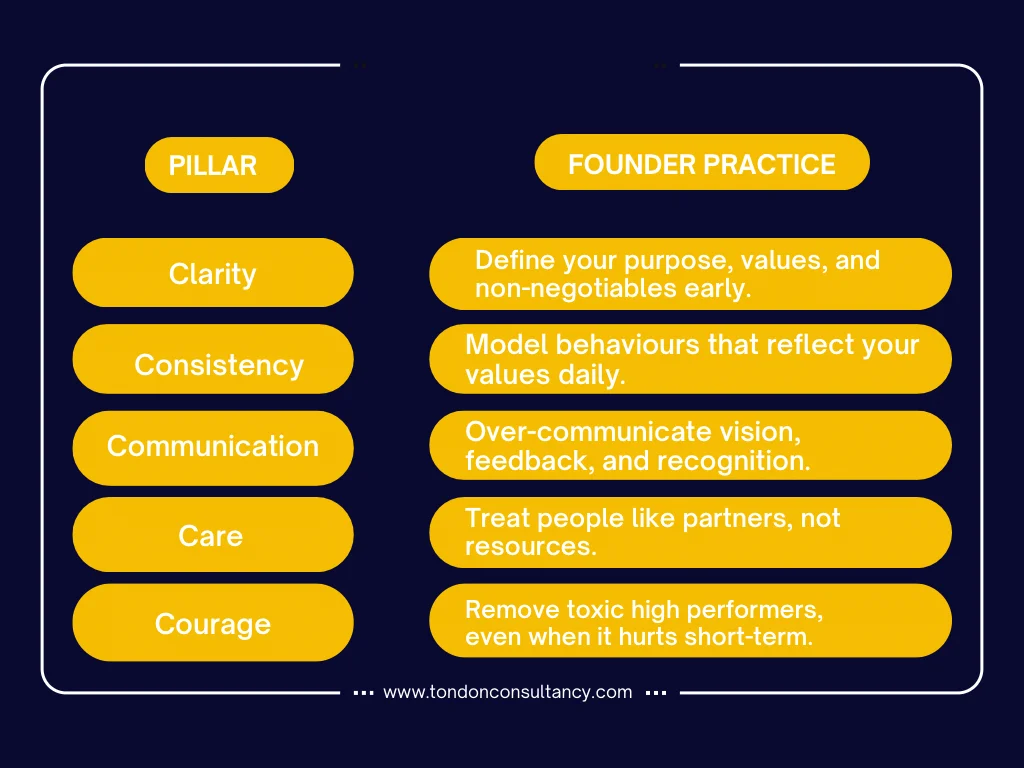
Remember: people don’t leave startups — they leave cultures.
️11. Final Thoughts: Culture First, Everything Else Next
If you’re a founder, this isn’t about adding “culture” to your to-do list.
It’s about realising culture is the to-do list.
Every email, meeting, and decision is writing your culture’s story in real time.
Ask yourself:
-Are we building a company people want to work with — or just one they work for?
-Will this culture still inspire us when times get tough?
-Would I still want to work here if I weren’t the founder?
Because when funding fades, markets shift, and strategies pivot, your startup’s culture decides whether it falls apart or fights together.
Startups don’t fail because they run out of money.
They fail because they run out of meaning, trust, and shared belief.
Closing Thought
You can raise capital from investors.
You can hire talent from anywhere.
You can pivot your product overnight.
But you cannot buy culture.
You have to build it — one conversation, one decision, one act of leadership at a time.
If you’re a founder, pause today and ask your team:
“What kind of company are we becoming?”
Their answers will tell you more about your startup’s future than your latest investor pitch ever could.