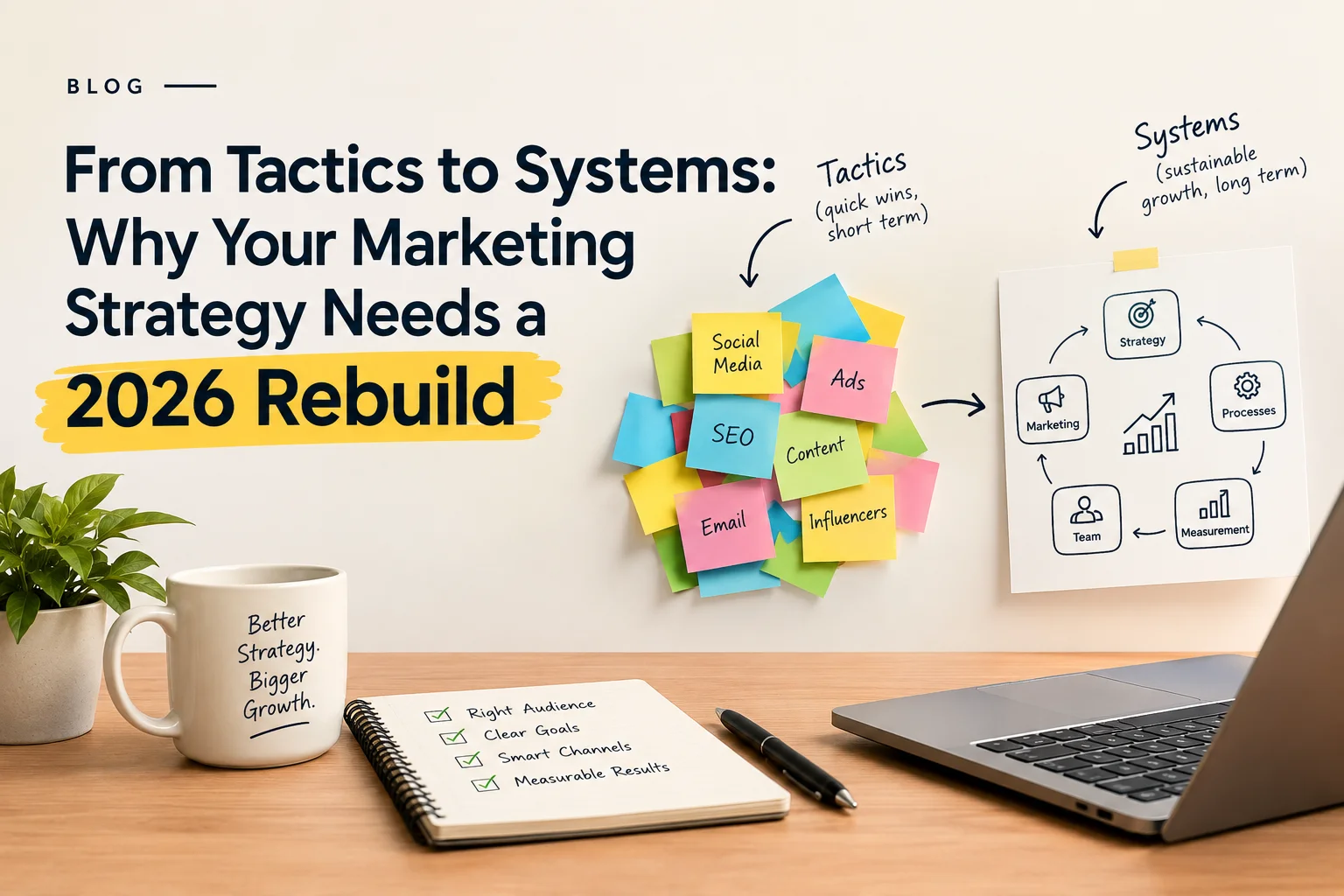
From Tactics to Systems: Why Your Marketing Strategy Needs a 2026 Rebuild
If you asked ten business owners what their marketing strategy looks like, most would describe a list: a few social posts a week, an email newsletter, maybe some paid ads, and a blog they update “when there’s time.” Each piece exists on its own island. Nobody is quite sure which one is actually driving revenue, and when growth slows, the instinct is to add one more tactic to the pile rather than examine how the pieces fit together.
That approach worked reasonably well for years, mostly because customers didn’t have many ways to research a business before buying. Today they do and the businesses winning in 2026 aren’t the ones running the most tactics. They’re the ones running the fewest disconnected ones.
The Shift: From Isolated Tactics to Connected Systems
The single most important change in marketing heading into 2026 is a move away from treating marketing as a bucket of separate activities and toward treating it as one connected system, where every tactic ties back to a measurable business outcome. Instead of asking “should we post more on Instagram?” the better question has become “what should happen after someone sees our Instagram post, and does our website, email flow, and sales process actually deliver that?”
This isn’t a subtle rebrand of old advice. It reflects a real structural change in how marketing departments are expected to operate. Marketing is increasingly treated as a growth function that owns outcomes, not a support function that produces content and hopes it helps. That distinction matters enormously for how a business should evaluate its marketing spend, its team’s priorities, and its own success metrics.
For business owners working with a consultant, this is often the single biggest unlock available to them not a new channel, not a bigger ad budget, but simply connecting what already exists.
Why Isolated Tactics Are Failing More Visibly Now
A few forces are converging to make disconnected marketing more costly than it used to be:
1. Buyers do more research before ever talking to you.
Prospective customers especially in B2B contexts now research a business extensively online before making contact. If your website, your content, and your sales conversations tell three different stories, or if your website doesn’t answer the questions your content raised, you lose people in the gap. A connected system means your blog, your landing pages, and your sales pitch are all reinforcing the same narrative rather than working against each other.
2. AI-driven search is changing how people find businesses at all.
A growing share of internet users now turn to AI tools to search rather than typing into a traditional search bar, and that number is expected to keep climbing over the next several years. This means content written to rank on a results page isn’t enough anymore it has to be structured clearly enough that an AI system can understand it, extract it, and cite it as an answer. A disconnected content calendar that never gets revisited or restructured is far less likely to survive this shift than a system where content is built, measured, and refined on purpose.
3. Attribution has become harder, not easier.
Even with better tools than ever, most marketing teams still struggle to prove which activities are actually responsible for revenue. When tactics are run independently one team handling ads, another handling social, another handling email nobody owns the full customer journey, and attribution becomes guesswork. A connected system doesn’t automatically solve attribution, but it makes it possible, because every piece is built with the same outcome in mind from the start.
4. Personalization only works within a system.
Personalized marketing consistently outperforms generic marketing it’s one of the more reliable findings in modern marketing data, with a large majority of marketers reporting it drives repeat business and increases sales. But personalization requires connected data: you can’t tailor an email to someone’s behavior if your email platform doesn’t know what they did on your website, or if your sales team doesn’t know what content they’ve already read. Personalization is a symptom of a connected system, not a tactic you can bolt onto a disconnected one.
What “Connected” Actually Looks Like in Practice
This doesn’t mean every business needs an expensive martech stack or a twelve-person team. Connected marketing is a mindset before it’s a set of tools. In practice, it usually means:
- One clear outcome per stage of the customer journey. Awareness content should be built to hand someone off to consideration content, which should hand them off to a decision-stage asset not exist as unrelated one-off posts.
- A single source of truth for what’s working. Even a simple spreadsheet tracking where leads come from and what they engaged with before converting is a connected system. A dozen unconnected dashboards is not.
- Consistent messaging across every touchpoint. Someone reading your blog, browsing your website, and getting on a call with your team should feel like they’re talking to the same business with the same point of view.
- Feedback loops back into content and strategy. If your sales team keeps hearing the same objection, that objection should show up in your content. If a blog post consistently drives conversions, related topics should get more investment. Right now, most businesses don’t have this loop — content gets published and forgotten.
Where AI Fits and Where It Doesn’t
AI is unavoidably part of this conversation, and rightly so: a large majority of marketers already use it for content creation, and many say the time it saves them goes directly into strategic work rather than production work. That’s a meaningful shift. AI can draft content faster, analyze customer data at a scale no human team could match, and even flag which parts of a marketing system are underperforming.
But AI amplifies whatever system it’s plugged into. If your marketing is currently a pile of disconnected tactics, AI will help you produce more disconnected tactics, faster. The businesses getting real value from AI in 2026 are the ones that built the connected system first and are now using AI to run it more efficiently not the ones hoping AI will substitute for a strategy they never built.
The Practical Starting Point
For a business owner who recognizes their marketing has become a pile of tactics rather than a system, the fix doesn’t start with more content or a new platform. It starts with three questions:
- What is each marketing activity actually supposed to accomplish, and does it hand the customer off to something else, or does it dead-end?
- Where do we lose people between first contact and a closed sale and which piece of the system is responsible for that gap?
- What does our data actually tell us, as opposed to what we assume based on gut feeling or industry best practices?
Answering these honestly usually reveals that a business doesn’t need more marketing. It needs the marketing it already has to talk to itself.
The Bottom Line
The dominant theme in marketing this year isn’t a platform, a format, or even AI — it’s intentionality. Every trend worth paying attention to in 2026, from AI-optimized content to personalization to better attribution, depends on the same foundation: a marketing strategy that operates as one connected system rather than a collection of separate bets.
Businesses that make that shift now auditing their current efforts, identifying where the gaps are, and building a strategy tied to measurable outcomes will be positioned to grow more consistently and more sustainably than competitors still treating marketing as a checklist. That shift is exactly where a strategic marketing consultation adds the most value: not by adding one more tactic to the pile, but by connecting the ones you already have.